Building an ornate chest of drawers is a rewarding project that blends structural cabinetry with decorative artistry. To achieve an "ornate" look, you’ll need tools for both the carcass construction and the intricate detailing.
1. Essential Woodworking Tools
These are the core tools required to build the frame and drawers of the chest.
-
Table Saw or Track Saw: Essential for ripping and cross-cutting large sheets of plywood or solid wood panels to size.
-
Miter Saw: For making clean, square cuts on the trim, molding, and drawer components.
-
Router & Bit Set: Vital for an ornate look. You’ll use this for creating decorative edges (ogee or chamfer), cutting "dado" and "rabbet" joints for the drawers, and adding recessed panels.
-
Pocket Hole Jig or Biscuit Joiner: To create strong, hidden joints quickly.
-
Cordless Drill & Driver: For assembly and installing hardware.
-
Clamps (Pipe, Bar, and Corner Clamps): You can never have too many. These hold the chest square while the glue dries.
2. Specialized Tools for "Ornate" Details
To move beyond a basic box and into "ornate" territory, you'll need tools that allow for fine embellishment.
-
Chisels and Mallet: For hand-carving details or cleaning up joinery.
-
Random Orbital Sander: To achieve a professional, glass-smooth finish across different grits (80 to 220).
-
Finishing Sprayer or High-Quality Brushes: Ornate pieces often look best with a layered finish (stain, lacquer, or furniture paint with a glaze) to highlight the carvings.
3. Required Materials
Choosing the right materials determines the longevity and "heft" of the piece.
| Category | Recommended Materials |
|---|---|
| Primary Wood | Hardwoods like Cherry, Walnut, or Mahogany carve beautifully. For a painted ornate look, Poplar or Maple are excellent, stable choices. |
| Secondary Wood | Poplar or Cedar for the drawer sides and backs; 1/4" Plywood for drawer bottoms. |
| Decorative Trim | Pre-milled Crown Molding, Base Molding, and Embossed Wood Appliqués (onlays) save hours of hand-carving. |
| Adhesives | High-quality wood glue (e.g., Titebond II or III). |
| Hardware | Ball-bearing drawer slides (for smooth movement) and decorative brass or glass pulls/knobs. |
4. The Finishing Touches
The "ornate" character usually comes alive during the finishing stage.
-
Wood Filler/Putty: To hide any nail holes in the trim.
-
Tack Cloth: To remove every speck of dust before sealing.
-
Topcoat: A polyurethane, wax, or lacquer to protect the wood. If you want an antique look, consider a dark glaze to settle into the crevices of your molding and carvings.
Pro Tip: The "Hybrid" Approach
If you aren't a master woodcarver, you can achieve an ornate look by building a sturdy, simple chest and "dressing it up" with architectural appliques and complex moldings found at specialized woodworking shops. It gives the appearance of custom hand-work with a much higher success rate for a first-time build. Integrating Gothic elements—like pointed arches, trefoil patterns, and dramatic dark accents—will transform a standard chest into a striking statement piece. Adding a mirror and trim "piping" (often referred to as beading or molding) requires a bit more precision in your layout.
1. Gothic Trim & Beading
To get that "piping" look on wood, you’ll want to use half-round molding or rope trim.
-
Materials: Look for flexible resin moldings if you plan on creating curved Gothic arches. For straight lines, hardwood "bead" molding works best.
-
The Look: Apply the trim in a "quadrifoil" or "pointed arch" pattern on the drawer fronts.
-
Tools: A Pin Nailer (23-gauge) is essential here. The nails are so thin they are almost invisible, preventing the delicate trim from splitting.
2. The Integrated Mirror
You can either mount a mirror to the back of the chest (vanity style) or inlay mirror panels directly into the drawer fronts or side panels.
-
Materials: 1/8" or 1/4" glass mirror. If you want a true Gothic vibe, look for "Antique" or "Distressed" mirror glass which has dark oxidation spots.
-
Adhesive: Use Mirror Mastic. Regular construction adhesive can eat through the silver backing of the mirror over time, causing black streaks.
-
Safety: Ensure the mirror is encased in a "rabbet" (a recessed groove) cut by your router, so the sharp edges are never exposed.
3. Essential "Gothic" Additions
To tie the mirror and piping together, consider these specific hardware and material choices:
| Element | Gothic Recommendation |
|---|---|
| Finishing | Ebony stain or Matte Black furniture paint. To make the "piping" pop, use silver or gold gilding wax on the raised edges. |
| Hardware | Cast iron "Drop" handles or ornate filigree backplates. |
| Mirror Frame | Use your router to create a pointed lancet arch frame for the mirror to sit within. |
4. Layout Strategy
Trace Your Arches: Before Cutting, use a template to trace Gothic arches on your drawer fronts.
Apply the "Piping": Glue and pin-nail your molding along these traced lines.
Inlay the Mirror: If putting mirrors on the drawers, the mirror should sit inside the molding "piping" for a recessed, framed look.
Seal the Edges: Use a dark wood filler or black caulk where the trim meets the mirror to ensure there are no visible gaps.
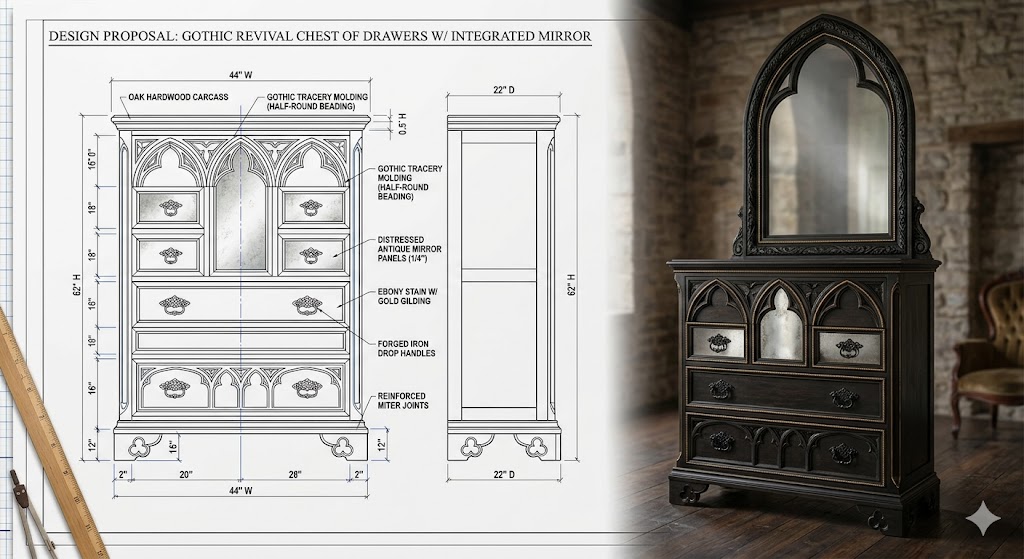
Would you prefer the mirror to be a large stationary piece attached to the top, or small decorative inlays on the drawers themselves?Here is a detailed design proposal for your custom Gothic chest of drawers. This visualization includes both a technical blueprint and a finalized 3D conceptual rendering.
The Gothic Design ConceptAs shown in the image, the piece is centered on strong, vertical lines and geometric symmetry, finished in a dark, matte ebony stain.
The "Piping": I have utilized half-round beading molding (as annotated in the blueprint) to create the structural borders. The defining ornate features are the arched Gothic tracery panels applied to the top section of the chest. This tracery forms pointed lancet arches on both the central mirror door and the surrounding small drawers, highlighted with subtle gold gilding to define the edges.
The Mirror Layout: This design uses a large, central arched mirror panel flanked by smaller drawers, creating a strong focal point. To enhance the Gothic feel, I've specified using distressed antique mirror glass. This slightly oxidized look provides an authentic, aged appearance that complements the dark wood and black iron hardware.
Key Blueprint Specifications:
-
Overall Dimensions: The chest is planned at roughly 44” Wide, 22” Deep, and 62” High, giving it a commanding presence.
-
Drawers: A six-drawer design provides varied storage. The four upper small drawers feature decorative mirrors, while the larger bottom drawers show complex tracery carving.
-
Hardware: Forged black iron drop handle